
Earth Day's Founding Act Is a Peace Compact
Earth Day's founding act is a peace compact among peoples who share one planet, timed to the equinox and carried by the Authentic Earth Flag that John McConnell created in 1969. This analytical term describes McConnell's historical peace-building purpose rather than the title of a signed treaty or an invented quotation. When educators restore this equinox observance to the classroom, planetary care follows logically from an explicit civic commitment to live together.
Busy instructors need the historical verdict before any background narrative. Lead the lesson with the peace compact, present the Authentic Earth Flag as its visible text, keep later April environmental observances beside this tradition rather than beneath it, and recover the peace root from primary documents associated with McConnell and Equinox Earth Day. Many schools open their seasonal curricula with cleanup rosters and species lists alone. Students can finish a campus service task without encountering McConnell's three-part civic frame—peace compact, equinox clock, and photographic Earth Flag. Practical ecology tasks become much clearer once students grasp a civic reason for planetary stewardship.
Three Founding Instruments
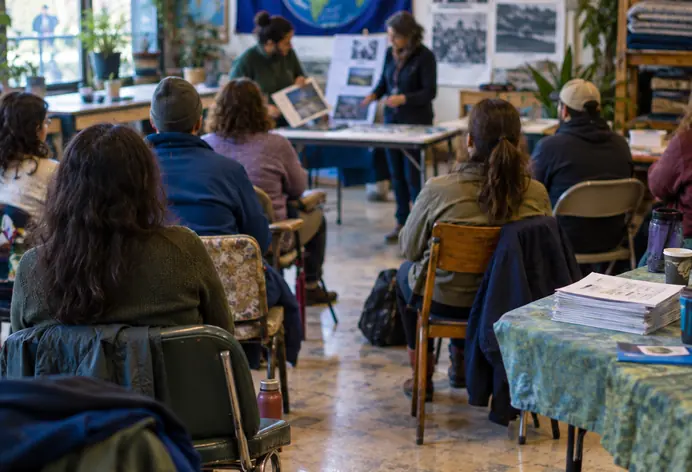
Anchor the Earth Day lesson in three verifiable classroom instruments: the peace compact as the interpretive civic frame, the March equinox as the shared astronomical date, and the Authentic Earth Flag as the visible primary emblem.
Five instructional moves bring this history into practice:
- State the peace compact before assigning any field activities.
- Examine the Authentic Earth Flag as a primary historical object.
- Explain the shared astronomical timing of the equinox.
- Pair the historical lesson with an existing later observance.
- Finish with a formal student address directed across hemispheres.
The Authentic Earth Flag as a Picture Both Sides Can Share
Begin classroom inquiry with direct visual observation rather than a lecture. The Authentic Earth Flag features a photographic image of Earth set upon a deep blue field; educators should display this specific historical emblem rather than substituting a generic globe illustration from a standard clip-art file. In the history of the Earth Flag, this photograph operates as an invitation to regard the planet as a shared home, serving a distinct communicative function compared to a partisan badge, a single-species icon, or a national device.
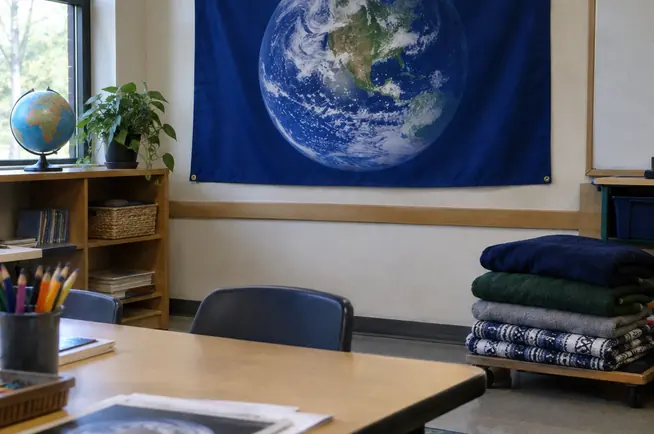
Keep the emblem in view throughout the discussion so that it stays the primary object under examination rather than a decorative backdrop for environmental advice. Ask students to distinguish visible features on the cloth from the civic meanings they infer. Viewers are invited to hold a planet in common before they debate policy programs, territorial borders, or whose regional spring calendar counts. While this comparison clarifies how different emblems communicate, it does not guarantee that all viewers will reach political agreement.
- One world pictured: The photographic image presents a single physical home in space, whereas a campaign banner asks the viewer to endorse a stated program.
- No political border legend: The surface lacks drawn territorial boundary lines, inviting recognition of a shared habitat before jurisdictional disputes begin.
- Shared sunlight: Natural light illuminates the photographed sphere, contrasting with text-heavy slogan banners that demand immediate alignment with a specific institutional campaign.
An Equinox Clock Both Hemispheres Can Claim
At the March equinox, the Sun crosses the celestial equator northward. The Northern Hemisphere enters astronomical spring while the Southern Hemisphere enters astronomical autumn. Daylight and darkness stand approximately balanced across the globe, though they do not measure exactly twelve hours everywhere because atmospheric refraction and the convention of measuring sunrise and sunset by the Sun's upper edge extend observed daylight.
Establishing this astronomical mechanics before discussing school calendars reveals how the equinox functions as a cooperation device. The equinox is one shared planetary moment worldwide, even though local clock times and calendar dates vary by longitude. Where documented Earth Trustee Initiative principles guide the lesson, the timing belongs directly to the peace compact. A pledge made on a clock that both halves of the planet can recognize teaches international cooperation before a single campus cleanup task is assigned.
Educators can offer students a plain formulation to record in their notes: The equinox gives different hemispheres a shared moment without asking them to share the same season. Treat the date as historical evidence that planetary care was framed as a meeting across difference. Before printing an equinox time on a school assembly program, require students to verify and record the specific year, local time zone, and astronomical source for that calculation.
What a Single National Story Leaves Out of Earth Day
Building a curriculum unit solely around one country's civic spring flattens a global peace-building origin into a local activity day. We do not need to claim that existing classrooms have been formally surveyed to see how different lesson architectures shape student work; we can compare instructional frames directly by what each asks young citizens to do.
Guard Historical Boundaries
Evidence for McConnell's emblem and equinox purpose does not establish ownership of every later Earth Day calendar, organization, or planetary symbol. Primary sources substantiate McConnell's peace-building line and its symbolism, yet historical coexistence and shared ecological concerns do not by themselves establish institutional ancestry or authorize an archive to rank existing observances.
When McConnell's peace-building line drops out of the syllabus, three pedagogical elements disappear: the equinox as a common clock, the Authentic Earth Flag as a common picture, and an explicit civic address reaching peoples beyond the school campus. Retaining both ecological science and practical service, a side-by-side comparison clarifies what the historical peace compact restores to the curriculum:
- Ecology-Only Frame: Asks students to study local environmental data, identify a campus or neighborhood pollution problem, and carry out a physical cleanup.
- Peace-Compact Frame: Retains the scientific study and the physical cleanup, while adding a written explanation of whom the activity serves globally and what cross-border cooperation planetary stewardship requires.
How to Read McConnell's Papers Beside Later Traditions
Select a short, attributable primary text associated with John McConnell or the equinox observance—such as a historical proposal, a proclamation, or an explanation of the flag—and pair it with a clear image from a verified flag gallery. Record the document's creator, date when available, document type, and retrievable archival location before writing historical claims around it. In my archival work examining 1969 Earth Day records and John McConnell correspondence, distinguishing a document's exact wording from later commentary prevents the flag-to-monopoly leap.
If a classroom lacks a verified primary excerpt, never invent quotations, document titles, archive names, or partner institutions. Instead, define the evidentiary target—language connecting peace, cooperation, and care of Earth—and have the teacher supply a citable text before presenting any quotation to the class. When preparing the visual source, retain the image's source caption and any available version or date metadata; a digital reproduction's upload date is never evidence of the flag design's original creation date.
The Three-Pass Archival Reading
- First pass (Peace and Cooperation): Students underline words that establish peaceful relations and mutual agreement among different peoples.
- Second pass (Planetary Care): Students mark phrases that describe practical stewardship and the physical protection of the Earth.
- Third pass (Stated Boundaries): Students identify the exact commitments or institutional limits expressed in the document. If the excerpt states no explicit boundary, students must record "none stated in this excerpt" rather than invent one.
Guide the discussion with three analytical questions: What does this source ask people to do together? What does it ask them to see? What does it leave to local practice?
A Forty-Five-Minute Civics Period a Teacher Can Copy Tomorrow
This proposed secondary civics or world-history lesson accommodates approximately 24 students in a standard classroom with no special budget or purchased activity kit. The instructor needs only a chalkboard or whiteboard, ordinary writing materials, one clear displayed or printed image of the Authentic Earth Flag, and one short teacher-verified McConnell or equinox excerpt. Dividing 24 students creates 12 working pairs for source analysis, while individual concluding addresses ensure a written contribution from every participant.
- Minutes 0–5 (Framing the Claim): Write the founding claim on the board in exact terms: Earth Day's founding act is a peace compact. Identify John McConnell's equinox tradition and explain that any April observance the school already keeps will stand alongside this lesson rather than be cancelled.
- Minutes 5–12 (Silent Visual Observation): Display the Authentic Earth Flag. Students examine the image silently and write down three distinct visual observations addressing the single pictured planet, the absence of a political border legend, and the shared sunlight illuminating the sphere.
- Minutes 12–22 (Paired Primary Reading): Read the teacher-verified primary excerpt aloud twice. Working in 12 pairs, students execute the three-pass reading to mark language of peace, cooperation, and planetary care, then write down any stated boundary—or record "none stated in this excerpt."
- Minutes 22–32 (Comparative Frame Analysis): Each student draws a two-column chart comparing an ecology-only assignment with what the peace compact adds, then writes down one concrete local act that expresses cooperative responsibility.
- Minutes 32–40 (Drafting the Public Address): Working individually, each student drafts a four-sentence civic address: sentence one greets both hemispheres on the equinox clock; sentence two names the Authentic Earth Flag as a shared picture; sentence three states one cooperative duty toward the planet; sentence four invites the school's later observance to stand beside the peace compact.
- Minutes 40–45 (Public Reading and Collection): In this classroom example, two volunteers read their four-sentence addresses aloud to the room. At the bell, the teacher collects all 24 written addresses as the lesson's formal assessment product and preserves them as potential primary material for a school assembly script.




Your Thoughts
Leave a comment.