
Key Takeaways
The case turns on connective tissue
The Earth Aware Network is best understood as practical connective tissue, not as a single command center.
That distinction matters. In planetary stewardship work, a flag, a campaign name, or a meeting can gather people for a moment; a network has to keep useful work moving after the gathering ends. Here, the connective functions were modest but consequential: shared communications, small-grant pathways, youth participation, and environmental reviews aimed at small and medium-sized enterprises.
When I map this case from first principles, I start with the actual problem a local organizer faces on a Tuesday afternoon: who can review a facility, who can fund a small project, who can bring young people into a live exchange, and who can help a conservation group avoid working alone?
- The network linked SMEs, youth programs, and conservation groups through shared services such as videoconferencing and small grants.
- The Eco-Efficiency Centre supplied environmental reviews and eco-business guidance for SMEs in Atlantic Canada.
- Cottonwood Foundation funding supported grassroots sustainability work, including youth-oriented programs and larger umbrella efforts.
- The dated record begins with a local conservancy formation in 1995 and extends at least through a May 2004 organizing milestone for a peace-oriented coalition.
Main Point: The case should not be flattened into the claim that online collaboration solved an environmental coordination problem; the record shows a mix of in-person stewardship, modest funding, technical review, and telecommunications.
Challenge: Fragmented Environmental Coordination
Commitment existed before coordination did
The first question was not whether people cared. They did.
The harder question was whether local commitment could travel across institutional boundaries without being diluted. A conservancy association working around an urban natural area needed volunteer coordination, site stewardship, and local ecological knowledge. An SME in Atlantic Canada needed a practical environmental review, not a ceremonial lecture. A youth program needed a live way to connect young people across distance, especially around Earth Day 2000.
Those are different needs. Treating them as one generic environmental problem would have produced a tidy brochure and very little operational value.
Three coordination gaps
The case record points to three gaps that kept recurring in different forms. First, grassroots organizations faced isolation. A local conservancy could form around a place, but it still needed channels to learn from adjacent stewardship efforts. Second, small businesses needed field-facing advice on eco-efficiency: reviews, follow-up guidance, and a way to translate environmental concern into facility decisions. Third, youth engagement required communications infrastructure capable of synchronous participation across time zones.
That last point is easy to underestimate now. For the 2000 KidCast For Peace exchange, the task was not merely to mail a finished educational packet. The task was to let young people participate in a shared moment, with visual work moving in analog and digital forms. A rural partner with no reliable video link could still exchange artwork or letters, but it could not participate equally in a live multi-site youth session.
Caution: Telecommunications can widen a circle only where the basic connection exists. In 2000-era conditions, unreliable digital infrastructure was not an inconvenience; it was a boundary on participation.
The Mount Tolmie Conservancy Association, founded in 1995, gives the challenge a concrete starting point. It was not a national headquarters model. Rather, it was a community association built around stewardship of an urban natural area. That local texture is important because environmental networks often become too abstract in retelling. The soil, trees, paths, volunteers, and municipal relationships come first.
Solution: Networked Services and Partnerships
Service design before institutional grandeur
The network response combined three service choices: technical review for small businesses, live telecommunications for youth collaboration, and small grants for grassroots groups.
This structure kept the collaboration relatively light. It did not require every partner to become the same kind of organization. The Eco-Efficiency Centre could concentrate on SMEs in Atlantic Canada, where environmental reviews and eco-business programs addressed facility operations and waste reduction. KidCast For Peace could use videoconferencing as its primary medium, with young participants contributing both hand-made visual material and digital submissions. Cottonwood Foundation support could move toward grassroots sustainability and youth projects without pretending to fund large public-sector programs.
Different partners, different tools
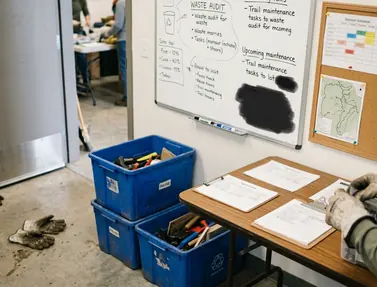
An SME environmental review and a conservancy work party do not belong in the same procedural manual. One asks how a workplace uses materials, manages waste, and identifies practical efficiencies. The other asks how volunteers care for a place, build trust, and maintain attention over seasons. The value of the network was that it did not force those activities into one template.
Program evaluation revealed a design logic that was simple enough to travel: give each partner a useful service, then let the relationship carry more than one kind of work. The youth side used videoconferences to make international participation visible. The conservation side used associations and stewardship models. The grant side favored small efforts where a modest award could help a group act.
- For SMEs, the working unit was the environmental review, paired with eco-business guidance.
- For young people, the working unit was the live exchange, supported by analog and digital art.
- For grassroots groups, the working unit was a small grant that could help a project take form.
- For umbrella coalitions, the working unit was coordination among already active organizations.
The Cottonwood Foundation pathway reached efforts such as the Global Youth Village summer camp, which served participants aged 11 to 18. It also touched larger organizing spaces, including the Coast Alliance, described in the case material as representing more than 500 groups. That range is instructive. The same network could brush against a summer camp, a conservation association, and a broad coalition without needing to own any of them.
Expert Tip: In a stewardship network, do not begin by asking every partner to adopt a uniform program. Begin by identifying the service each partner can actually use within its own operating conditions.
Results: Documented Organizational Impact
Continuity is the strongest evidence here
This is not a case where impact can be reduced to a single campaign metric. The better measure is organizational continuity: named functions persisted, groups formed, youth exchanges took place, and issue-specific advocacy remained connected to broader stewardship channels.
The earliest dated marker is the Mount Tolmie Conservancy Association in 1995. The case then points to similar stewardship models with arboricultural and aquacultural focus. That sequence matters because it shows replication by function rather than branding. The underlying idea was not simply to create more committees; it was to give local ecological care a durable civic form.
Earth Day 2000 as a working test
The Earth Day 2000 KidCast videoconference tested a different part of the network. A residential youth program, Global Youth Village, connected with additional communities abroad during a late-April global observance period. Young participants did not merely listen. They produced visual work in hand-made and digital forms, which gave the collaboration a public trace beyond minutes, rosters, or institutional letters.
That public trace has educational force. A drawing made for a peace-oriented Earth Day exchange does not carry the same policy weight as an environmental review, but it carries memory. It lets a young person see planetary stewardship as something spoken, made, and shared with peers elsewhere.
The record also extends beyond the original conservation and youth-exchange examples. A peace-oriented coordinating body had a May 2004 establishment marker. Advocacy examples such as Baby Milk Action and the International Nestle Boycott show the network touching issue-specific campaigns as well as place-based conservation work. The Peace Alliance, established in May 2004, marks another organizing strand in the documented period.
Evidence checks for educators and historians
The record is useful, but it is not uniform. Some claims rest on dated organizational markers, while others rest on program descriptions and partner references. That calls for careful reading, especially in classrooms or public history settings.
- Case claim: A local conservancy provides the earliest dated organizational marker. Best supporting material: archived association records or local stewardship documentation. Detail to confirm: the 1995 founding date and the association's stated conservation purpose.
- Case claim: The youth exchange used live telecommunications. Best supporting material: KidCast For Peace program materials. Detail to confirm: the Earth Day 2000 videoconference format and the role of youth artwork.
- Case claim: The network connected small local groups with larger coalitions. Best supporting material: partner descriptions and grant references. Detail to confirm: the scope of the Coast Alliance and the grassroots orientation of Cottonwood Foundation support.
Stakeholder feedback indicates that these kinds of networks are often remembered through their events. The deeper result is quieter: organizational pathways remained available after the event ended.
Scope and Limitations of the Network Model
Where the model was strong
The Earth Aware Network worked best where partner organizations, communications capacity, and small-grant relationships already existed.
That is not a weakness to hide. It is the operating condition of the model. Coverage was strongest in North America, with selected international partners connected through youth and advocacy channels. Technical consulting and environmental review services were available through certain providers, including Environmental Consulting & Design, while grant support remained directed toward grassroots efforts rather than large governmental programs.
In practical terms, this means the network could help a community group move, a youth program connect, or an SME examine environmental practice. It could not, by itself, replace land-management authority, stable public funding, or permanent local staff.
Where the model narrowed
The telecommunications requirement created the clearest boundary. A community without reliable digital exchange capacity could still participate through slower forms of correspondence, but it could not join a live multi-site session on equal footing. That distinction is not technical trivia. Participation design shapes who gets heard.
Grant distribution had its own boundary. Cottonwood Foundation support targeted grassroots sustainability efforts and youth-oriented projects. That focus gave small organizations a pathway, but it did not make the network a substitute for large-scale public programs. Environmental consulting also depended on available providers and local relevance. An Atlantic Canada SME review would not automatically translate to a conservancy association managing volunteers around an urban natural area.
Main Point: This model is best read as a collaboration-and-services case, not as proof that a loose environmental network can replace sustained local staffing, public funding, or long-term land-management authority.
What the case teaches now
The lesson is disciplined humility. Build the service that fits the work. Let youth collaboration look like youth collaboration. Let SME review look like technical assistance. Let conservancy formation remain rooted in place.
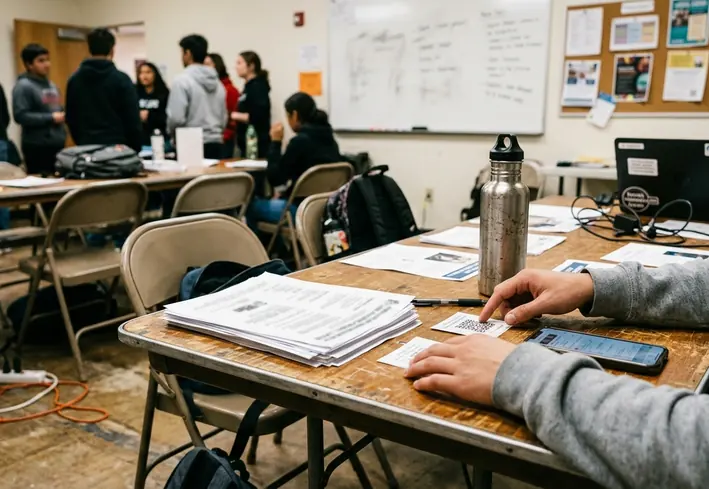
The reverent part of planetary stewardship is not only in the symbol we raise. It is in the patient architecture underneath: the meeting link that includes another classroom, the small grant that lets a camp run a project, the environmental review that turns concern into practice, and the local association that keeps returning to the same patch of ground.
That is the enduring value of the Earth Aware Network case. It shows collaboration as a craft, assembled from specific tools and bounded by real conditions.



Your Thoughts
Leave a comment.