
Contents
- Key Takeaways for the Classroom
- What Students Lose When the Two Earth Days Are Treated as One
- Equinox Earth Day and the April 22 Teach-In Tradition
- Classroom Timeline Prompts
- The Earth Flag’s Place Between the Two Observances
- Discussion Questions That Keep Origins Distinct
- Primary-Source Activities Teachers Can Run Tomorrow
- Building One Period or a Three-Day Mini-Unit
- Common Teaching Pitfalls
- Two Clocks, One Planet
Key Takeaways for the Classroom
Put March 21, 1970, beside April 22, 1970, and ask students what separates the dates. The first marks John McConnell’s inaugural equinox observance in San Francisco. The second marks the first large-scale United States teach-in observance associated with Senator Gaylord Nelson and national coordinator Denis Hayes.
Students need three distinctions they can retrieve later: date logic, organizing purpose, and symbolic language. McConnell chose an astronomical event to express planetary peace and unity. Nelson and Hayes used a fixed April date to organize environmental education and civic participation. The history of the earth flag belongs in the lesson after those two streams have names.
A Five-Line Retrieval Card
- John McConnell
- March equinox
- Planetary peace
- Gaylord Nelson and Denis Hayes
- April 22 teach-ins
Preserve The Distinction
Teach the observances as parallel traditions. Students should be able to explain why each date was chosen before they interpret the shared language of Earth, responsibility, or environmental concern.
What Students Lose When the Two Earth Days Are Treated as One
I begin with a deliberately incomplete sentence: “Earth Day began in 1970.” Students usually sense the gap. A historian still needs a date, founder, place, purpose, and source.
Reserve four to six minutes for this diagnosis and require at least two qualifiers. A student might revise the sentence by identifying McConnell’s March 21 observance in San Francisco. Another might specify the April 22 teach-in campaign. The exercise turns a familiar holiday label into a source-literacy problem.
Careful teaching allows students to hold two legitimate traditions at once. Careless compression carries two risks: McConnell’s equinox vision disappears behind April 22 classroom logistics, or the civic organizing behind April 22 shrinks into a footnote beneath planetary symbolism.
A poster titled “Earth Day” cannot settle the question by itself. Students must inspect its date, organizer, audience, and stated purpose. That habit extends well beyond the earth day legacy; it teaches them to resist identifying a source solely through its most prominent words.
Equinox Earth Day and the April 22 Teach-In Tradition
McConnell publicly proposed an Earth Day tied to the March equinox in October 1969. San Francisco observed the resulting Earth Day on March 21, 1970. His calendar choice placed attention on a planetary event rather than a national anniversary.
Scientific precision matters here. An equinox is the instant when the Sun crosses the celestial equator. “Equal day and night” works as classroom shorthand, although atmospheric refraction and the conventions used to measure sunrise and sunset prevent exact equality in most places. The March equinox can also fall on March 19, 20, or 21 across years and time zones, so teachers should consult the published instant for the year under study.
Nelson announced plans for a nationwide environmental teach-in in September 1969. The first April 22 observance followed in 1970, with Hayes coordinating the national campaign. Its language emphasized public education, environmental problems, policy attention, and mass participation.
Parallel Purposes
- Equinox stream: planetary peace, whole-Earth consciousness, and an astronomical marker shared across borders.
- April 22 stream: environmental teach-ins, civic organizing, public education, and a recurring civil-calendar date.
- Shared ground: concern for Earth and a desire to move public attention toward responsibility.
This comparison preserves McConnell’s framing and the Authentic Earth Flag legacy without suggesting that two United States-linked histories encompass every Earth Day practice developed elsewhere.
Classroom Timeline Prompts: From Proposal to Parallel Observances
Give students unsorted evidence before supplying a finished chronology. A card enters a column only after the group identifies a clue establishing date, authorship, intended audience, or ritual form.
Four Chronological Anchors
- October 1969: McConnell publicly proposes an Earth Day tied to the March equinox.
- March 21, 1970: San Francisco holds the inaugural equinox observance.
- April 22, 1970: the large-scale United States environmental teach-in observance takes place.
- February 26, 1971: United Nations Secretary-General U Thant signs McConnell’s Earth Day Proclamation.
Prepare about ten to twelve cards: four for the equinox stream, four for the April 22 stream, and two to four covering shared concerns or later symbolism. In a 50-minute class, allow eight minutes for sorting, pause for a three-minute source check, then give students four minutes to revise.
Useful card headings include founder intent, calendar choice, audience, ritual form, and lasting institutional path. This structure avoids a single linear “winner” narrative. It also leaves room for a shared-symbol column without collapsing the origins.
Test The Evidence
Insert one mixed pairing midway through the lesson, such as placing McConnell under April 22. Give students 60 seconds to correct it with a date, phrase, or source feature.
The Earth Flag’s Place Between the Two Observances
McConnell developed his Earth Flag in 1969. Versions place a full-disk photograph of Earth at the center of a dark blue field, making the planet itself the represented community.
Discussion Questions That Keep Origins Distinct

A national flag usually marks a bounded political community. The Earth Flag directs the eye toward a shared home with no political borders visible. That symbolic choice aligns closely with McConnell’s planetary framing, yet the flag can connect discussion across both observances once students understand their separate origins.
An early lesson sequence placed the flag at the opening. Students then read it as generic April 22 branding. Moving the artifact analysis after the two-column history solved the problem because students had enough context to distinguish association from origin.
A Six-Minute Artifact Protocol
- Observe silently for 90 seconds.
- Describe visible features with a partner for two minutes.
- Spend 90 seconds making a historical inference.
- Use the final minute to revise an initial caption.
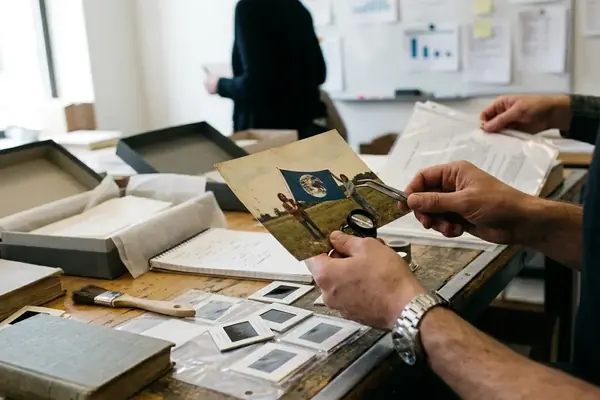
Students should inventory field color, placement of the Earth disk, presence or absence of words, and whether political borders appear. Displaying the image for no more than about half a minute during the initial observation can sharpen recall, provided description is collected separately from interpretation.

Sequence discussion from observation to interpretation and then civic judgment. Students first identify what a source says or shows. They next connect that evidence to one historical stream. Only then do they debate the advantages and limits of a date, teach-in, proclamation, or flag.
Middle-School Stems
- “The date matters because ___; my clue is ___.”
- Why might McConnell have chosen an equinox?
- Why would organizers choose a fixed April date for teach-ins?
- When can a flag persuade an audience more quickly than a lecture?
High-School Stems
- “The source frames environmental responsibility as ___, which differs from ___ because ___.”
- How does an astronomical calendar change the intended audience of an observance?
- When does a whole-Earth image clarify history, and when might it oversimplify it?
- How can later institutional adoption alter public memory of an origin?
Give each student two evidence chips. A student spends one by naming a document phrase, date, or visible artifact feature before making an interpretive claim. Run the discussion for seven to nine minutes, followed by a two-minute correction beginning, “I first grouped this evidence with ___, but now I place it with ___.”
Primary-Source Activities Teachers Can Run Tomorrow
Choose one source for each evidentiary job. A compact packet usually produces closer reading than a broad archive assembled for coverage.
Three Source Stations
- Equinox rationale: Students annotate McConnell language about peace, Earth as a shared home, and astronomical timing.
- Teach-in material: Students examine a 1970 poster or schedule for audience, calls to action, organizers, and local versus planetary framing.
- Flag artifact: Students observe, sketch, and write a caption that connects the symbol to McConnell without erasing the April 22 tradition.
Keep excerpts to roughly 180 to 300 words. Number lines in blocks of five so students can cite precise language during discussion. At the flag station, require a caption of about 35 to 50 words containing a visible description, a historical connection, and one sentence distinguishing the observances.
For a gallery walk, post six timeline cards and allow 45 seconds at each. Students may correct a founder-date pairing only by attaching a source reference. End with a synthesis letter capped at around 120 words that includes John McConnell, the March equinox, Gaylord Nelson or Denis Hayes, and April 22.
How to Build One Period or a Three-Day Mini-Unit
Plan backward from the distinction students must make: one tradition uses an astronomical moment to express planetary unity; the other used a fixed April date to organize environmental education and civic action.
A 50-Minute Lesson
- Five minutes: ambiguous-origin hook.
- 12 minutes: source comparison.
- Eight minutes: timeline sort.
- 10 minutes: Earth Flag analysis.
- 10 minutes: evidence-based discussion.
- Five minutes: exit ticket.
The exit ticket should contain three sentences. Students identify McConnell’s calendar logic, identify the April 22 organizing model, and explain why the flag does not make the histories identical.
A Three-Day Sequence
- Day 1: Study the 1969 and 1970 origin records.
- Day 2: Examine equinox science, planetary symbolism, and the flag gallery as an artifact set.
- Day 3: Conduct source-supported student teach-backs.
For emerging writers, provide sentence frames while retaining proper nouns and dates. Advanced students can examine how proclamations, annual rituals, and later adoption affect which origin the public remembers.
Common Teaching Pitfalls
Audit each slide for unsupported compression. Whenever a date appears, attach an intent clause. Whenever the flag appears, attach an artifact caption. A claim about large participation requires a clearly identified source.
The frequently repeated figure of 20 million April 22 participants should not appear as an independently counted attendance total. If a lesson retains it, label it as a widely cited historical estimate and identify the source carrying that estimate.
Write Full Origins
Use this formula: “On [date], [person or group] used [form of observance] to pursue [purpose].” It keeps a date from standing in for founder, method, and intent.
Before teaching, rehearse one exact distinction aloud: “McConnell’s Earth Day followed the March equinox, while the April 22 observance grew through the U.S. environmental teach-in campaign.” That sentence gives every later activity a stable historical spine.
Two Clocks, One Planet
The strongest closing comparison concerns two kinds of clock. One observance follows a celestial event calculated for the whole Earth; the other returns through the civil calendar that schools and civic groups can organize around.
Give students 45 seconds to complete the contrast aloud: “The equinox is timed by ___; April 22 is timed by ___.” Then display the Earth Flag as the connective symbol: two observances, one planet, and a home depicted without political borders.
At the equinox, the Sun crosses the celestial equator at one global instant; April 22 returns by calendar date.





Your Thoughts
Leave a comment.