

Guiding Principles for Earth Day Legacy
- Ceremonial practice authored much of the Authentic Earth Flag’s public meaning.
- Civic, educational, and peace settings each taught different facets of Earth as a shared home.
- Programs, photographs, and press mentions show how posture, sequence, and silence framed the flag.
Ceremony Authored the Symbol Before Design Did
The Authentic Earth Flag became a planetary emblem primarily through ritual use. John McConnell proposed an Earth Day tied to the March equinox in 1969. The first observance followed in March 1970. The Apollo 17 photograph commonly called the Blue Marble was made on December 7, 1972. Public Earth Day ritual preceded the photographic design now most closely associated with the flag.
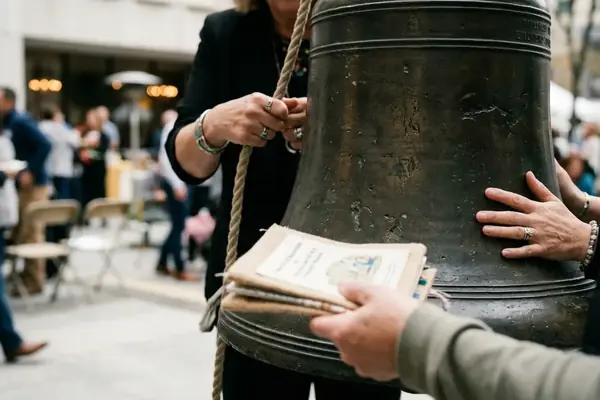
The United Nations observance developed around a compact sequence centered on the equinox. Participants listened to remarks about planetary peace. They witnessed the ringing of the Peace Bell, which was presented in 1954. Raising, carrying, flanking speakers, and standing in silence assigned roles the cloth could supply only through active participation.
Civic Ritual and the Raised Earth Flag
Municipal Earth Day programs, proclamations, and plaza gatherings placed the flag beside civic authority without replacing national flags. A civic ceremony is reconstructed from relationships among sources. The proclamation supplies official language. The program supplies order. Photographs supply spatial evidence.
The order of ceremony taught a hierarchy of attention and reverence. Where historical press clippings detail the event, the reporting confirms that shared-home language in mayoral remarks linked local place to a planetary scale. For each surviving program, historians record four items verbatim. They note the opening action, the first appearance of the Earth Flag, the named reader or speaker, and the closing action.
A photograph can establish pole position, sight lines, neighboring flags, and crowd orientation. A caption or program is needed before assigning ceremonial meaning to those arrangements. Given the fragmented nature of early environmental archives, these surviving programs represent cumulative evidence of practice rather than a universal municipal script.
Classrooms, Assemblies, and First Encounters
School assemblies and classroom displays often gave children their first non-national flag experience tied to Earth. The educational sequence is kept deliberately shorter and less martial than a conventional flag ceremony. A usable classroom sequence can fit within about four minutes.
The sequence begins with a carry-in of roughly half a minute. A student then delivers a reading of no more than 120 words. The group observes 20 to 30 seconds of silence, followed by a one-sentence transition to the day's lesson. For younger pupils, the reading names visible or familiar systems. Teachers highlight air, rain, soil, food, and oceans instead of introducing abstract terms such as planetary governance. Educational framing stressed interdependence and care.
Peace Gatherings and Shared Planetary Reverence
Peace-oriented marches, vigils, and interfaith gatherings used the Earth Flag as a non-national rallying cloth. Peace use is classified by the flag's ceremonial job rather than by the sponsoring group. The United Nations Peace Bell became central to the equinoctial Earth Day observance associated with McConnell's planetary-peace tradition.
Source descriptions distinguish three positions that are often collapsed into a general presence. The flag was carried at the head of a walk, fixed beside a speaking platform, or raised on a permanent pole. Walking with the flag, planting it at a meeting point, or flanking speakers signaled unity without state allegiance. Silence, song, and spoken pledges to the planet created a distinct emotional register from patriotic pageantry.
What Programs, Photographs, and Press Mentions Reveal
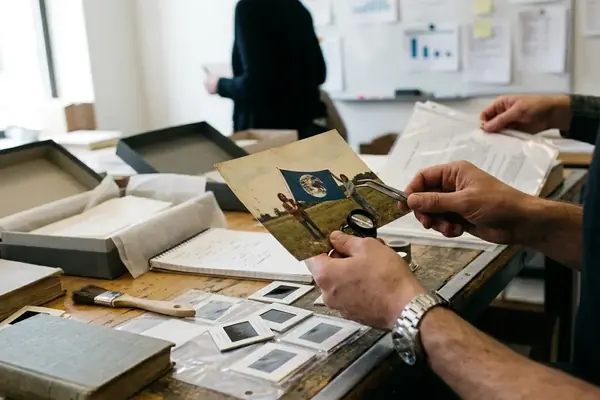
A flag-only image search was tried and dropped because it produced many photographs without dates, captions, or evidence of sequence. The stronger method begins with dated programs and clippings, linking the visual record to a specific ceremonial timeline. Printed programs fix sequence. They document when the flag appears, who handles it, and what words accompany it.

Photographs capture posture, showing hands on a halyard, children facing the cloth, and crowds oriented toward a raised point. Press language shows how reporters translated ceremony into public understanding of Earth as home.
The Apollo 17 source image is cataloged as AS17-148-22727. Preserving that identifier prevents confusion with later crops, color adjustments, and mirrored reproductions. A source log should capture the date, location, document type, quoted ceremonial verb, flag position, and named handler. It also notes whether the image records preparation, the formal act, or dispersal afterward.
How Ritual Practice Forged Planetary Identity
The causal claim is kept narrow. A single ceremony cannot prove that participants adopted a lasting planetary identity. The evidence instead shows repeated rehearsal of that identity through synchronized action. Repeated ceremonial acts trained audiences to feel membership in a planetary community. Identity formed through shared timing, shared silence, and shared orientation to one object.
The chronology from the 1969 proposal through the March 1970 observance and the December 1972 Blue Marble provides a bounded period for testing whether ceremonial language persisted while the flag's visual form evolved. For contemporary reuse, the flag should enter or rise at a named point in the program. It must remain the visual focus for at least the reading and silence. Displaying it throughout as undifferentiated stage decoration removes that transition. The flag worked as a rehearsal tool. People practiced thinking as Earth citizens before they debated policy.
Dawn on the Courtyard Flagpole
The morning air holds a slight chill in a small school courtyard at first light on an April 22 Earth Day. While McConnell's original observance is identified separately with the March equinox, this modern school vignette aligns with the widely used classroom calendar. A student steps forward to clip the upper and lower fasteners to the halyard.
They raise the Authentic Earth Flag while classmates stand without an anthem. Another student reads a short statement about one shared planet. The cloth catches wind above bare trees—a quiet focal point for the gathered students. The group holds a moment of silence. The ceremony ends in quiet, and the students return to their classrooms without applause.





Your Thoughts
Leave a comment.