
Key Methodological Takeaways
The method begins by treating Apollo imagery as historical evidence before treating it as design material. Candidate images are first sorted by whether the whole Earth is legible. The reference image most often used as a control example is Apollo 17 frame AS17-148-22727. It serves this role because it is a complete sunlit Earth view and is widely documented in public archives.
Primary comparison sets use whole-Earth and near-whole-Earth Apollo frames. Apollo 8 and Apollo 17 imagery are kept in separate folders because their viewing geometries differ sharply. Variation by context means that Apollo 8 Earth views may support a more distant, crescent-like planetary reading, while Apollo 17 whole-Earth imagery supports a centered disk suitable for emblem design.
A typical review pass is scheduled over roughly ten working days. Three days are dedicated to archive identification. Two days go to mission-log cross-checking. Another three days involve visual reduction sketches, with the final two reserved for review notes.
Main Point: Treating archival photography as historical evidence ensures the resulting symbol remains anchored in a specific human achievement rather than abstract geometry.
Source Selection Protocol
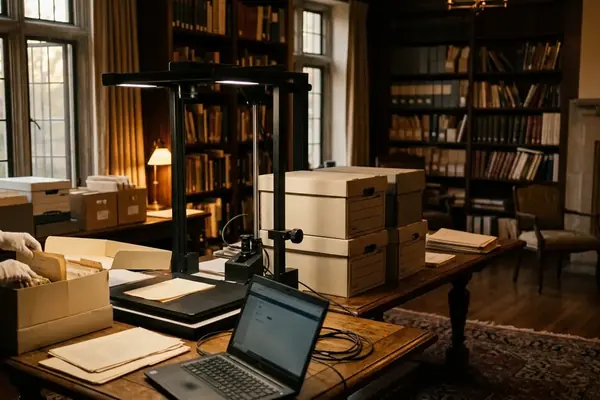
Image selection starts with mission-origin confirmation, not visual appeal. A frame is admitted only after its archive caption, mission context, and guaranteed public-domain status agree closely enough to avoid historical ambiguity. The minimum source record captured for each accepted image includes the mission number, magazine or roll identifier when available, frame identifier, archive URL or catalog location, caption text, and date of access.
Cross-verification is performed against mission transcripts, image-library captions, or flight-summary documentation. This happens before the image is moved from the intake folder to the drafting folder. The intake log separates images into three bins—accepted primary reference, contextual reference, and rejected derivative copy.
Strict binning prevents modern digital composites from contaminating the historical reference pool. This careful sorting protects the meaning of the final design.
Controlled Variables in Symbol Adaptation
The adaptation stage controls scale, color, and symbolism separately so that one correction does not quietly alter another. First, the Earth disk is centered and measured. Then, land-water contrast is established.
The Earth limb is treated as the governing geometry. Drafts are rejected if the outer circle is hand-adjusted into an oval or if cloud masses are used to redefine the planet's boundary. Color is limited to muted ocean blue, cloud white, and subdued land tones derived from the reference print or archival scan. This keeps the color faithful to the original film characteristics. We avoid the high-saturation blue that is common in later digital reproductions.
Symbolic neutrality review removes flags, mission labels, spacecraft silhouettes, typographic slogans, and continent outlines that imply ownership or hierarchy.
Caution: Using a bright modern Earth composite can produce a visually pleasing symbol, but it breaks the Apollo-based method because the image no longer reflects a single historical photographic moment.
Tool Application and Drafting Sequence
Drafting proceeds from physical observation to digital testing. The first pass is made on a printed reference to force attention to the image’s large forms rather than pixel-level artifacts. Analog tracing uses matte prints no smaller than 8 by 10 inches. A transparent overlay sheet is placed on top, and a light gray circular guide is drawn around the Earth limb.
Only after this physical grounding does the process move to a screen. Digital proportion testing uses three layers. The original reference sits at the bottom. The traced planetary disk forms the middle layer. The simplified symbol draft rests on top, with the source layer locked during comparison.
Peer review is conducted in two rounds. One review checks for historical-source traceability. The second review evaluates symbolic clarity, with comments logged directly against the draft date. While these archival sources provide a solid foundation, the methodology relies heavily on the visual acuity of the individual drafter during the analog tracing phase. This sequence keeps the final design tethered to its photographic origins.
Replication Guidance and Limitations
A researcher applying the same protocol should begin with a small, named set of Apollo frames rather than searching broadly for attractive Earth images. The order matters immensely. Verify the source, document the context, and only then begin visual extraction.
The recommended replication sequence is strict. Collect source records. Save unaltered reference copies. Print the selected frame. Trace the Earth limb. Create a simplified disk. Test small-size readability. Archive the decision log.
A complete replication packet should include the original archive citation, one annotated reference image, one analog tracing scan, two dated digital drafts, and a final rationale paragraph. A practical classroom-oriented output size test is about 1.5 inches wide on a printed page, because small reproductions quickly reveal whether the symbol depends on fragile cloud detail.
Expert Tip: This method is limited to historical Apollo imagery and should not be extended to later satellite composites, artistic renderings, or post-Apollo Earth-observation datasets without rewriting the source-selection rules.







Your Thoughts
Leave a comment.