
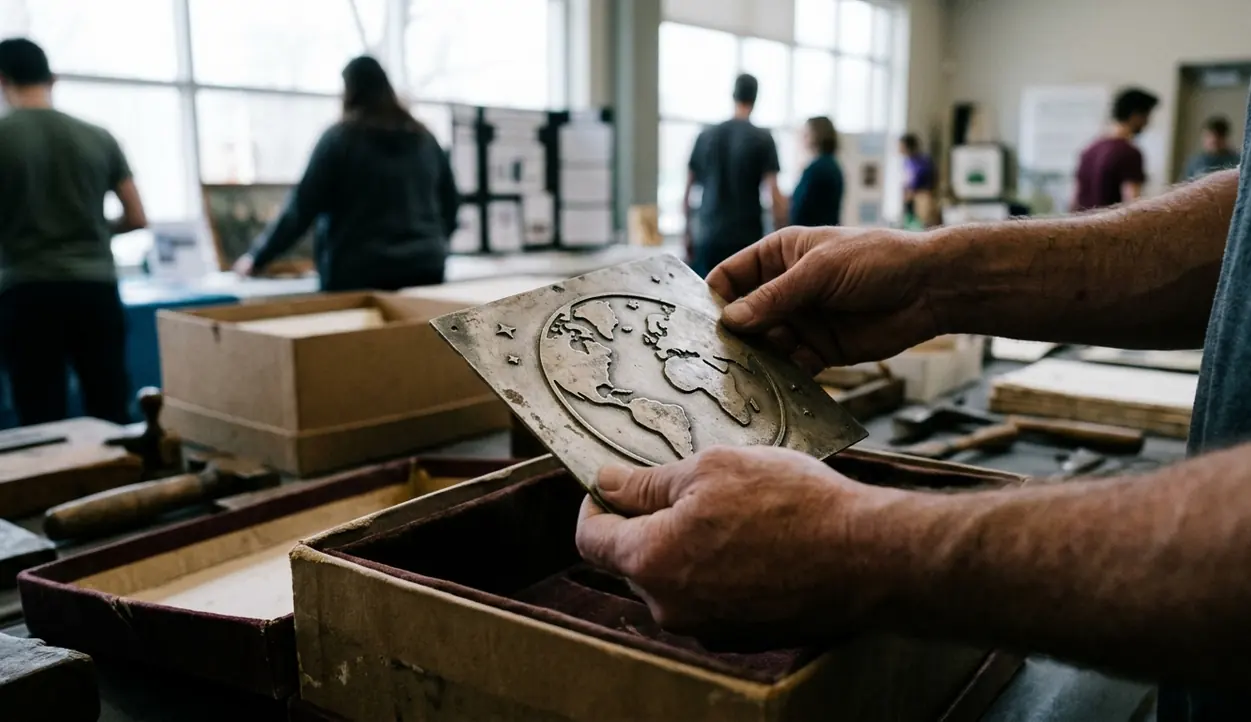
What a Classroom Loses If McConnell's Earth Flag Never Reaches Design History
A student who meets the Authentic Earth Flag only as seasonal environmental decoration never practices reading a designed emblem. When a curator or teacher files the banner strictly under activist chronicle, that pedagogical miss becomes permanent. The history of the earth flag belongs inside twentieth-century graphic and vexillological study, right alongside municipal standards and modernist corporate marks, because its visual authority comes from deliberate formal choices rather than sentiment alone.

One class period is enough to test the cloth as graphic design if the instructor knows which questions matter. A single 35-to-45-minute classroom allocation covers direct observation, comparative analysis, and a short written attribution exercise; this schedule serves as a practical lesson plan rather than a measured learning outcome. During the session, learners practice a method for reading public symbols.
Four tests decide the case before a single historical battle is recounted. Students begin with a one-sentence baseline description—one space-derived image of Earth on a deep blue field—and immediately apply four diagnostic questions:
- Who designed it? (Testing authorship and formal rules)
- What does it omit? (Testing visual economy and absence)
- What changes when it is copied? (Testing material state and reproduction)
- What allegiance does it invite? (Testing civic function without a state)
A blue field and a planet are grounds for initial examination, never sufficient evidence on their own for attributing an object to John McConnell's specific design. Resemblance gets a banner into the classroom comparison, but authorship, visual economy, reproduction, and allegiance determine how it is read.
Putting John McConnell's Name Back on the Emblem
Begin by placing John McConnell's name beside the physical object before introducing a single line of biography. McConnell proposed his Earth Flag in 1969, a date that anchors its conception squarely within twentieth-century design history rather than treating it as a recent environmental graphic. When educators separate visual description from provenance, the classroom dynamic shifts. Students describe the deep blue field and the photographic Earth image in front of them, while the instructor supplies the reproduction's documented attribution and source.
Teaching authorship this way frames the creator's role as responsibility for an emblem's structural rules rather than a personal life story. Across any digital or physical flag gallery, learners frequently encounter blue-field, planet-centered banners that borrow the general look without sharing the same design intent. To run a clean comparison, use a documented McConnell reproduction as the reference object. Retain the source caption, credited designer, and any available production date alongside the image. When bringing in a secondary, generic globe banner for contrast, identify an unattributed comparison banner simply as unattributed rather than assigning it an invented maker.
This method establishes a sharp historical boundary. Crediting the emblem's designer is a distinct historical claim from authenticating the particular cloth pinned beside a classroom chalkboard. Naming McConnell establishes design responsibility for the emblem he proposed in 1969; it does not establish that he manufactured, approved, or personally supervised every later copy circulated by an earth flag foundation or commercial vendor.
Blue Field, One Earth, Nothing Else: Reading the Flag's Visual Economy
Set a stopwatch for a 4-to-6-minute looking interval before supplying any interpretive caption. Unhurried observation forces students to confront the strict economy of the composition. Guide the room through a fixed four-step looking order:
- Field: Examine the deep blue surrounding space and how it establishes the ground.
- Figure: Inspect the single space-derived photograph of Earth positioned at the center.
- Edge: Distinguish the rectangular edge of the flag from the curved edge of the depicted planet—one boundary belongs to the textile carrier, the other to the photographic image.
- Absence: Name the conventional vexillological devices that are completely missing.
The entire design can be spoken in a single sentence. It consists of a deep blue field and one space-derived Earth image, operating without a motto, canton, stars, or coat of arms. When students compare this spareness with denser twentieth-century institutional symbols, they see the difference through visible mechanics: fewer marks on the cloth mean fewer competing hierarchies to decode.
Even within this minimal formula, precision matters. A reproduction can preserve the basic blue-and-planet formula while quietly changing the specific Earth photograph, its rotational orientation, its scale relative to the cloth, or its exact placement on the field. Spotting those shifts trains the eye to treat the emblem as a calibrated graphic specification.
Printed Image, Sewn Cloth, Raised Banner: Three States of the Same Emblem
Design history and environmental history meet at the exact moment a flat graphic becomes a banner people stand under. To track this transformation, walk the emblem through three distinct material states: a flat printed reproduction, a sewn cloth flag, and a ceremonial raising. Each medium contributes physical properties that the graphic formula alone does not contain.
Print fixes the image on a static page where lighting and geometry remain constant. Cloth introduces weave texture, hems, structural seams, folds, and a reverse side. A ceremonial raising introduces wind movement, a steep viewing distance, and a public gathering. Where documented earth trustee initiative archives preserve ceremonial records, the shift from paper concept to hoisted textile marks the core of the earth day legacy.
Students can document these transitions by compiling a classroom object record. Label the sheet a "teaching description" to distinguish its pedagogical purpose from a professional conservation assessment. Have the class record five concrete details:
- The material carrier (paper stock, printed synthetic, or woven bunting)
- The observed field color under room lighting
- The specific image source, when documented on the packaging or caption
- The attachment method along the hoist edge (grommets, sleeve, or heading tape)
- The visible physical condition of the specimen
On a textile specimen, students should inspect the hoist edge, hems, seams, and reverse before discussing how the emblem behaves in motion. Photograph the teaching specimen lying flat on a worktable and hanging freely from a mount so the class can compare the unobstructed Earth image with the exact same photograph interrupted by gravity and folds. Keep the analytical scope tight during this exercise: this material reading trains students to observe physical carriers, so it does not inventory every historical variant, settle trademark or rights questions, or measure how often the flag is flown globally.
Allegiance Without a Capital: The Earth Flag Beside a National Flag
Set up a paired display at the front of the room featuring the Authentic Earth Flag beside one national flag. Attach separate, readable captions to both specimens so the arrangement functions as a structured analytical comparison rather than an unexplained ceremonial display. Begin with strict visual description, avoiding any ranking of personal loyalties.
Ask students to list each emblem's graphic devices alongside the political or social community associated with it. A national banner relies on state heraldry, revolutionary stripes, or constitutional stars tied to a specific capital and bordered territory. Then ask the room what changes when the principal figure is a photograph of the whole planet. The Earth Flag asks for a planetary identification that nation-centered flags are built to exclude, inviting recognition of a shared biosphere without depicting a capital city or territorial boundary.

Framing the Civic Question: Ask students, "What community does each emblem ask the viewer to recognize?" This keeps the inquiry focused on design function rather than suggesting that raising a planetary banner cancels a national flag's civic or legal standing.
To anchor the ceremonial state of the flag in time, introduce McConnell's March equinox observance as the calendar most closely tied to his emblem. When preparing the lesson caption, look up the exact equinox date and time for that particular year and local time zone rather than assigning the observance a permanently fixed calendar date. Present this equinox connection as the specific display context for McConnell's design, noting that it represents one documented strand within the broader history of Earth Day traditions.
Late Light Before the Equinox: One Cloth Flag and a Student List
Late afternoon light angles across a history classroom on the day before the March equinox. Pinned to the corkboard beside a pull-down textbook map of the world is a small cloth Earth Flag, accompanied by a printed source caption naming John McConnell and the 1969 proposal.
At the chalkboard, the instructor taps the four diagnostic tests written in chalk. For the final five minutes of the period, notebooks open for a two-sentence closing exercise: write one sentence describing the emblem's formal structure, and one sentence explaining what the textbook map's inked borders do that the flag's photographic Earth does not. Pencils move as students look up from their desks to the corkboard, checking the pinned textile against the polychrome map of sovereign states.
On the board, the class's final compiled list stands in four neat lines: McConnell; blue field and Earth; print, cloth, raising; planetary allegiance. Just under three feet to the left, a soft vertical fold drops through the center of the pinned cloth flag, creasing the cloud cover over the photographed ocean while the textbook map beside it holds its printed borders flat.







Your Thoughts
Leave a comment.