

McConnell Asked UNESCO to Receive a Planetary Day
John McConnell's proposal at the 1969 UNESCO Conference on the Environment marks the starting point for this account of the Authentic Earth Flag because he asked an international audience to receive a planetary day and that flag together. When educators and historians trace the history of the Earth Flag, starting with this specific hearing anchors the symbol in a deliberate public act. A classroom or archive looking for a clear chronological beginning finds it in the moment a citizen stepped before a world forum to propose a shared civic observance for the whole Earth.
This historical starting point rests on three distinctions:
- The international forum he chose: McConnell brought his idea to a gathering already assembled around environmental concerns across national borders.
- The pairing of day and flag in one proposal: The interpretive claim of this origin lesson links the recurring calendar observance directly with the visual emblem of the planet.
- The duty to keep subsequent origin narratives labeled as later: Maintaining chronological clarity requires educators to teach the 1969 proposal first and identify subsequent public calendars by their own dates.
Why the Conference on the Environment Was the Floor
A symbol representing the whole Earth has no natural national owner. Because a planetary emblem invites reception beyond the institutions of any single country, a purely domestic unveiling could never carry the full weight of the claim McConnell was making. He needed a floor that matched the scale of the idea.
The 1969 UNESCO Conference on the Environment provided that setting. Here was an international audience already gathered to address environmental questions, making the assembly suited to receive a planetary idea rather than a local banner. For historians and advocates working within the Earth Flag Foundation and related educational archives, the practical fit between a planetary symbol and an international environmental assembly explains why the setting matters to the lesson. This approach relies on the 1969 conference setting as the primary historical point of reference, placing the original hearing ahead of the flag's subsequent circulation.
When preparing materials around this event, a rigorous curriculum separates three distinct elements:
- McConnell's proposal: The specific call for a planetary observance brought before the assembly.
- The audience receiving it: The international environmental delegates gathered at the 1969 conference.
- Any institutional response: Keeping the act of proposing separate from claims of official organizational adoption.
Keeping these three elements distinct clarifies the historical account. The authority of the Authentic Earth Flag in this lesson begins with the international audience it was brought before, establishing its civic purpose long before the wide popularity of the image took hold.
Pairing the Authentic Earth Flag with the Proposed Day
At the center of this instructional model is the pairing of two distinct civic tools: McConnell brought a proposed Earth Day and the Authentic Earth Flag he created before that international audience as one cohesive concept. Understanding why these two elements belong together in the lesson requires looking at their complementary functions. A designated day gives the flag a recurring civic job, calling people to attention on a regular schedule. In turn, the Authentic Earth Flag gives the day a visible planetary referent, anchoring an abstract calendar date in the concrete image of the shared globe. Offered together, neither functions as a spare emblem.
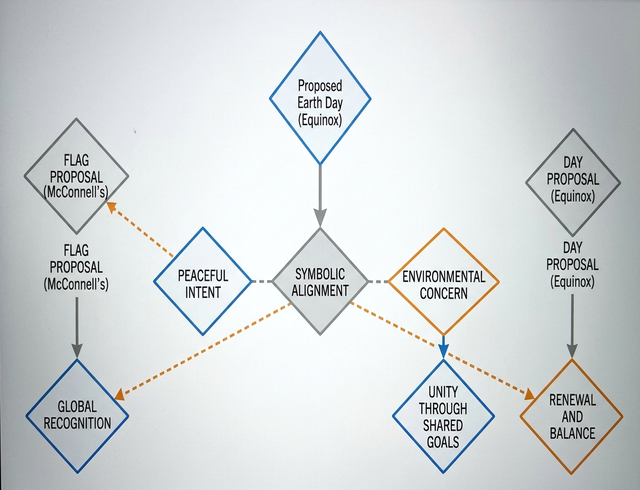
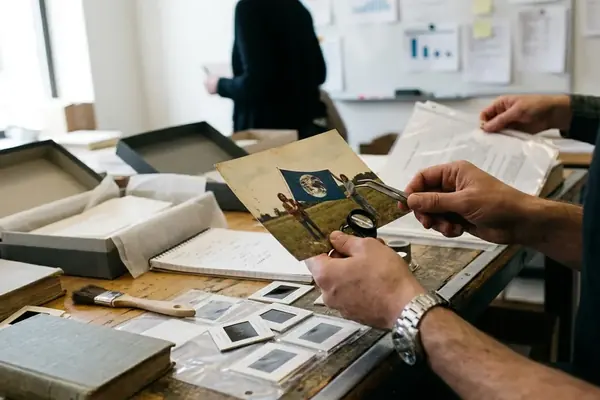
Teaching this functional relationship allows an instructor to introduce civic purpose before showing the visual image. When organizing the historical account, the account stays with the documented shape of the act: the proposer, the year, the conference forum, and the paired proposal. During source preparation for a flag gallery or classroom unit, an archivist extracts separate evidence for the proposed day and for the flag's presence, recording the exact document title and page or archival location for each item. A later photograph of the flag is never treated as evidence that it accompanied the 1969 presentation.
The Flag–Date–Hearing Breakdown
An image identifies the symbol, a calendar identifies an observance, and the 1969 hearing identifies the proposal's historical setting. Keeping all three aligned prevents a visual emblem from floating free of its civic history.
By focusing on how the observance and the symbol reinforce each other, educators preserve the integrity of the Earth Day legacy while respecting the boundaries of the historical record.
The 1969 Act, Held Apart from Later Origin Stories
Clarity in historical education depends on stating plainly what can be taught as the core act: in 1969, at the UNESCO Conference on the Environment, John McConnell placed a planetary proposal—Earth Day together with the Authentic Earth Flag—before an international audience. Establishing this baseline gives students a fixed point in time before they encounter the complex web of later environmental history.
Once the 1969 act is firmly in place, a curriculum can introduce subsequent public calendars and competing origin narratives as later frames. Teaching materials work best when organized into two strict chronological groupings: the 1969 proposal in the first group, and subsequent observances or retrospective interpretations in the second. When a later narrative or calendar date enters the discussion, the instructor identifies that material by its own date rather than folding it back into a reconstructed conference account.
If a detail—including the joint presentation of Earth Day and the Authentic Earth Flag—cannot be tied to the 1969 proposal through a contemporaneous source, teach it as later context or interpretation rather than as an established part of McConnell's presentation. This single rule protects the classroom from retroactive storytelling and keeps the conference-floor boundary intact. Learners see the 1969 hearing for what it was, and they meet later public observances on their own chronological terms.
What the Hearing Reset for Day and Flag
Giving the proposal an international hearing changed the interpretive setting for both the calendar day and the visual emblem. Once the idea had been carried into a world environmental forum, the Authentic Earth Flag could be read as an instrument of public purpose brought before an international body, and Earth Day's origin could be taught through that hearing alongside any subsequent observance.
This distinction serves three audiences preserving the Earth Trustee initiative and its history:
- Educators gain a sequence: Instead of starting with a familiar poster and working backward, teachers have a chronological starting point that leads naturally from a civic problem to a proposed solution.
- Historians gain a forum-and-act unit: Researchers have a defined assembly, a specific year, and a public proposal to investigate and document.
- Advocates gain a grounded symbolism: Those who carry the flag forward can explain its planetary meaning through a public proposal for stewardship rather than relying on visual display alone.
In practice, this reset shapes what a presenter can do in a lecture hall or museum space. The speaker names the 1969 conference, explains the proposed observance, introduces the flag's functional relationship to that purpose, and only then brings in subsequent calendars. Throughout captions and teaching scripts, careful presenters keep the words "proposed," "presented," and "endorsed" distinct, ensuring that a change in interpretive setting is always communicated with historical precision.
How to Present the Flag as Part of the 1969 Proposal
Structuring an origin lesson around the 1969 hearing requires a deliberate choice in instructional order. A unit on the history of the Earth Flag can follow any of these three sequences, each with a different classroom dynamic.
- Flag-first order: The instructor displays the image, invites visual interpretation, and later supplies the historical setting.
- Date-first order: The instructor names a familiar annual observance, discusses calendar associations, and then looks back toward the historical setting.
- Hearing-first order: The instructor introduces the proposer and the 1969 forum, explains the proposed observance, and then introduces the flag and its planetary purpose.
Selecting the hearing-first order gives learners a concrete historical question to solve before asking them to interpret an image or recall a calendar date. To follow this order, open any origin lesson with the UNESCO Conference on the Environment, the year 1969, and John McConnell's name before the Authentic Earth Flag is shown.
Once the forum and the proposer are on the board, unveil the flag and ask learners to state the flag's job in one sentence drawn directly from the hearing: it serves as a planetary idea carried to an international audience. When a later national Earth Day date enters the classroom conversation, place it chronologically after the 1969 proposal and label it clearly as a later public calendar.
A Single Class Hour on McConnell at UNESCO
A single 60-minute class hour can follow this sequence, using only the historical case already established.
Minutes 0–10: State the Claim and Forum. Write John McConnell, 1969, and the UNESCO Conference on the Environment on the board while keeping the flag covered. State the lesson's core claim: that this 1969 proposal is the origin lesson for the Authentic Earth Flag, and outline the evidentiary basis separating contemporaneous records from later interpretation.
Minutes 10–20: Examine the International Floor. Ask your students why a symbol meant for the whole Earth needed a world environmental conference as its floor. Guide the discussion until the class articulates that a planetary emblem has no single national owner, making an international assembly gathered around environmental concerns the fitting audience to receive it.
Minutes 20–35: Recount the Paired Act. Uncover the Authentic Earth Flag and recount the proposal as a day and a flag offered together. Have students map out the functional pairing in their notebooks: the observance provides a recurring occasion for civic attention, while the flag provides a visible reference to the planet. Remind them to keep the historical evidence of the Earth Day proposal distinct from the interpretive framing of the paired symbol.
Minutes 35–45: Place Later Calendars in Sequence. Draw a timeline on the board. When students bring up subsequent public calendars and later Earth Day dates, write those dates to the right of the 1969 mark, label them as later frames, and bring the class's attention back to the original UNESCO hearing.
Minutes 45–55: Synthesize the Four Elements. Pair students up and ask them to explain to one another the exact relationship connecting the proposer, the international audience, the recurring observance, and the planetary symbol.
Minutes 55–60: The Unprompted Recall Check. Take the Authentic Earth Flag down and erase the timeline so no poster prompt remains in view. Ask each learner to write down one complete sentence explaining what John McConnell asked that international audience to receive in 1969. When a student writes that McConnell asked an international environmental conference to receive a planetary day and the Authentic Earth Flag together as a shared civic commitment, that final sentence confirms the hour held the historical act together.






Your Thoughts
Leave a comment.