
The Separation of Print and Provenance
The history of the earth flag begins with its creation by John McConnell, designed to provide a single, unifying symbol for the planet. As the Authentic Earth Flag appeared at early Earth Day gatherings, it was captured by volunteer cameras on personal film during outdoor events. These snapshots moved from processing envelopes into classroom files, civic displays, and family albums. Each move detached the print from handwritten dates or adjacent frames. The working order for reconstruction is fixed. Identify the flag generation and visible setting first, then locate dated comparables.
The intake protocol demands strict attention to the physical container. An original processing envelope often bears a pharmacy stamp or a handwritten note that provides a geographic anchor. Assigning one record to each physical print establishes a clear chain of custody. List every accompanying object, including album pages, mounts, clippings, or handwritten slips, before separating anything for scanning. Photograph the front, back, borders, and original container during the same intake session. Record dates exactly as written. Preserve forms such as a month without a year exactly as found.
The physical context of the photograph holds the first clue to its origin. A specific brand of photo paper can narrow the timeline before the image itself is analyzed. This rigorous intake prevents the loss of subtle contextual clues that might otherwise be discarded as mere packaging.
Extracting Evidence from Cloth, Hardware, and Emulsion
Examine the flag before interpreting the crowd. Record the Earth-disc crop and orientation, field color, edge finish, stitching, attachment points, pole, and finial as separate observations. This cloth–hardware–print chain forms the foundation of the analysis. Grommet edges often show distinct manufacturing marks, while stitch paths reveal whether a flag was commercially produced or hand-sewn by a local community group. Next, inventory the surrounding scene. Clothing cuts, protest signage, vehicles, architecture, and vegetation bracket a season and a decade.
Finish with the print itself. Distinguish features visible in the photographed scene from marks introduced by processing, copying, or mounting. Scan a small photographic print at 600 ppi in color. Include the full border and at least 5 millimeters beyond each edge. Save an unsharpened TIFF master and make a separate working copy for enlargement.
Use a 6× to 10× loupe to inspect paper fibers, stitch paths, grommet edges, retouching, and processing marks. Transcribe faint marks character by character. Use brackets to indicate unreadable positions. The texture of the flag's fabric, visible under magnification, differentiates an early canvas production from a later synthetic reproduction. Every scratch on the emulsion or fold in the paper adds a layer of physical history to the visual record.
Building a Reliable Comparison Set
Construct the comparison set from images with traceable captions, dated album context, or contemporary publication. Compare flag construction and photographic generation before subject matter. Place comparison candidates in a contact sheet with identical crops of six features. These include the Earth-disc edge, disc orientation, upper hoist corner, lower fly corner, attachment hardware, and pole top.
Require at least two independent physical correspondences—such as the same repair plus the same hardware placement—before describing two frames as possibly showing the same flag. Repeating folds alone provide weak evidence because storage and hanging alter them. The contact sheet method forces the researcher to look at the flag as a physical object rather than a symbolic image. By isolating the upper hoist corner or the pole top, the eye catches subtle variations in fabric tension and hardware alignment.
The flag gallery assembles and annotates these comparisons as an educational research record. This documentation work cannot confer archival certification or turn an unsupported resemblance into a definite date. By focusing on the physical wear and tear of the flag, researchers track a single banner across multiple events. A frayed lower fly corner documented in a May gathering might appear in an undated autumn photograph, linking the two images through the object's unique lifecycle.
Conducting Unbiased Witness Outreach
Prepare witness outreach only after the visual evidence ledger is complete. Send an uncropped image and a detail view without a proposed year, city, or list of names. Ask the witness first to describe what is visible. Then ask where they believe the scene occurred, how they know, and which parts remain uncertain.
Conduct an initial interview for about 20 to 40 minutes. During this time, silence is often as informative as speech. Allowing the witness time to study the uncropped image without interruption yields the most accurate spontaneous recognition. Separate spontaneous recognition from information recalled after prompts. Record exact uncertainty phrases such as “I think,” “someone told me,” or “I was there.”
Securing Corroborating Documentation
Send a written summary within roughly three to seven days. Ask the witness to correct names and distinguish firsthand memory from later family knowledge. Request any album, school record, newsletter, or local newspaper that could corroborate the account. Human memory reshapes itself around suggestions, making the unprompted initial reaction highly valuable. When a witness identifies a specific homemade pole or a distinct schoolyard fence, that detail must be cross-referenced with the visual ledger to ensure it aligns with the physical evidence.
Structuring a Three-Layered Caption
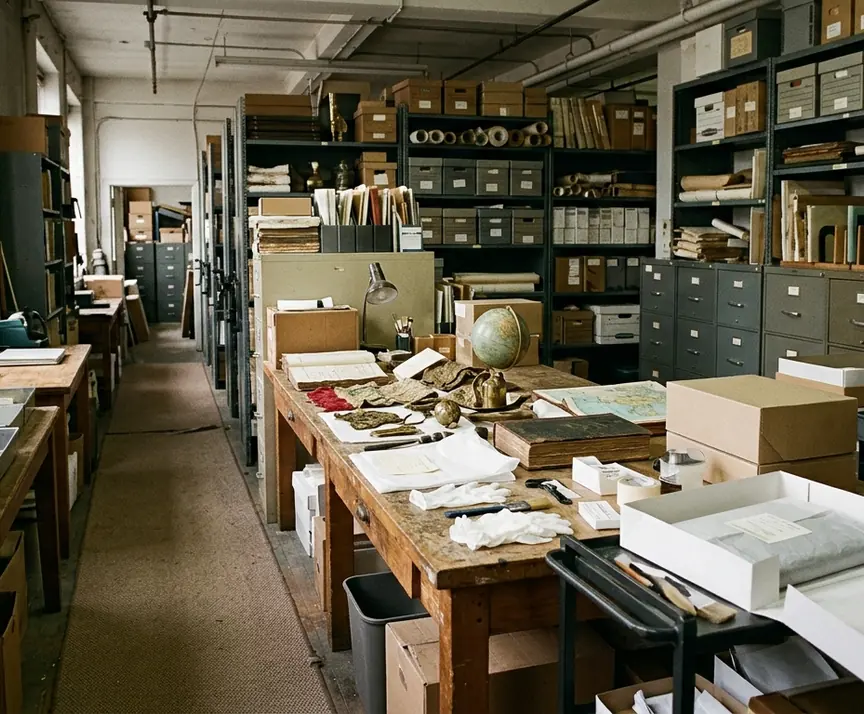
Draft the caption directly from the established evidence ledger. Move direct visual facts into the first layer. That first layer acts as a strict visual inventory, listing only what can be definitively seen, such as a canvas flag with two brass grommets attached to a wooden pole. Place bounded interpretations into the second layer, which suggests a likely decade based on vehicle models or clothing styles visible in the background. Leave unresolved date, location, and identity fields in the third layer.
A second reviewer must be able to trace every public statement to the scan, the reverse of the print, a dated comparison, or a documented witness statement. Use controlled date language. State an exact day only when directly documented. Use a month or season when corroborated. Apply a year range when the evidence merely brackets the image. Write “date unknown” when no defensible interval exists.
- Give every research note a last-checked date in YYYY-MM-DD format.
- Retain the previous caption when revising it.
- Ensure an identification never erases the path by which it was reached.
The discipline of the three-layer caption prevents assumptions from hardening into accepted facts. By explicitly stating what is unknown, the record remains open to future discoveries without misleading current researchers.
Restoring the Historical Record
When a place or date is recovered, reconnect it to the evidence. Preserve the earlier unknown-status caption and cite the item that resolved the question. Explain whether the discovery identifies the gathering, the physical flag, the photographer, or only the setting. This missing-witness boundary means a recovered schoolyard may identify where McConnell’s banner was raised without identifying the day or every person beneath it.
Create a revision entry containing the former caption, revised caption, evidence consulted, reviewer initials, and revision date. Do not overwrite the earlier state without an audit trail. If a new identification depends on a witness, seek one documentary cross-check before removing “unconfirmed” from the research note. Every documented act of participation strengthens the historical record. When a previously uncaptioned photograph is finally linked to a specific civic square or classroom display, it ceases to be a generic illustration and becomes a verified piece of history.
The earth flag foundation relies on this meticulous accumulation of verified details. A recovered caption restores a specific moment of civic participation to the broader earth day legacy, often highlighting early grassroots efforts akin to the earth trustee initiative. John McConnell designed one banner to stand for one planet. Each recovered caption returns a single copy of that banner to the schoolyard, civic square, or classroom where it was actually raised, one dated print at a time.





Your Thoughts
Leave a comment.