
The Cost of an Unlabeled Archive
The few details that truly matter in any historical image are the creator John McConnell, the Earth Day lineage of the flag, the occasion, and the location. Everything else is atmosphere. Publish or share an Authentic Earth Flag photograph without a date, names, and a place, and later readers lose the ability to recover who made, carried, or first flew it. The caption is reduced to facts that can still identify the historical record. Descriptions of mood, color, or composition come only after those foundational facts are secured.
For educators, historians, and environmental advocates, the loss of context is immediate and concrete.
An uncaptioned digital file quickly becomes anonymous cloth. Without a name on a physical print, that identity is usually gone for good. A usable record requires four factual fields: date, names, place, and occasion, plus the clear identification of the Authentic Earth Flag and its creator. Recording those fields during the same handling session in which a print is scanned or a digital file is accepted preserves the link between the image and the people who can identify it. Postponing the task until publication separates the visual evidence from human memory.
When Decorative Cropping Erases Human History
Consider two treatments of one photograph. One version appears as a website banner or presentation slide with no credit attached. The other exists as a documentary record that names the specific gathering, the year, and the individuals who stood holding the Authentic Earth Flag. The uncropped documentary frame serves as the reference object. Decorative cropping, stock-style reuse, and untitled social media posts detach the flag from its Earth Day origins and from McConnell's original design.
A visual edit easily becomes a historical edit.
Before making a banner or slide crop, archivists must copy the original caption into the derivative record and preserve the names of visible flag holders or speakers. A documentary entry distinguishes at least three roles when known. These include the person who created the flag, the person carrying or displaying that particular flag, and the person who made the photograph. Keeping the source image and each decorative derivative in one folder, with the caption saved beside them before the banner, slide, or social version is distributed, prevents this erasure.
Reverence without provenance fails the historical record. Hanging the flag as digital or physical décor while omitting the human record treats memory as optional.
Establishing the Four-Part Minimum Record
Stewardship for Earth Flag images relies on a specific set of caption fields. The foundation includes the calendar date or at least the year, the personal names of the maker, holder, or speaker, the city or site, and the occasion. That occasion might be an Earth Day observance, a classroom lesson, a public march, or an archive display. The record must also identify the object itself as the Authentic Earth Flag created by John McConnell, distinct from a generic planet graphic.

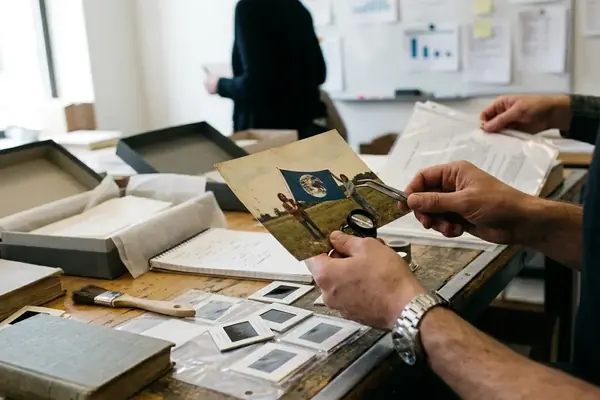
The process begins with evidence physically attached to the object. Archivists look for handwriting on the print verso, an envelope, a contact sheet, a filename, or an existing catalog entry. Only supported details transfer into the caption. The order normalizes to date, names, place, and occasion—a sequence that prioritizes historical retrieval.
Readers must mark unresolved fields as unknown. Guesswork damages the archive.
An honest blank serves history better than an invented hometown. Use a full calendar date when documented. Otherwise, retain the narrowest supported form, such as a month and year or a year alone. Do not convert an estimated decade into a precise year.
Standardizing the Earth Flag Gallery Record A model pattern reads: '[Date or unknown date] — [Name or unidentified person] holds the Authentic Earth Flag created by John McConnell at [place or unknown location] during [occasion or unidentified gathering]. Photograph by [name or unknown].'
The Drift from Documented Lineage to Timeless Myth
Test the historical record by asking what a reader could establish from a photograph without access to the current custodian's memory. Four common failures require separate checks: a missing date, missing personal names, a missing location or occasion, and the failure to identify the object as McConnell's Authentic Earth Flag.
An undated rally print cannot establish the occasion. Website hero crops often hide the nearby signs that provide context. In a classroom poster, the globe image may survive while McConnell's name is dropped entirely. A reprint credited only to 'Earth' removes every traceable human role.
These missing caption fields turn a photograph of McConnell's Authentic Earth Flag into anonymous blue cloth.
Myth fills the vacuum left by missing facts. The flag starts to look timeless, authorless, and interchangeable with any blue-marble graphic. This myth-making directly impacts Earth Day memory. Without a caption, later viewers cannot tell a first-generation flag from a later replica or a different planetary emblem.
A globe-bearing flag qualifies as an Authentic Earth Flag photograph only when the object or its record supports that identification. Visual resemblance alone does not establish lineage. Keep generation claims qualified by writing 'later print,' 'possible replica,' or 'version not established' unless the physical object, dated source material, or a reliable catalog record supports a firmer identification.
A Repeatable Method for Image Custodians
Educators, environmental advocates, and historians benefit from a repeatable sequence. Inspect the full image and any physical housing first. Read the verso and transcribe labels exactly. Check the filename and neighboring files for sequence clues. Contact the holder or donor while identification is still possible. Draft the date, names, place, and occasion line before creating another copy.
Allocating Time for Uncataloged Photographs
For an uncataloged photograph, reserve roughly 15 to 30 minutes for a first pass. Spend 5 to 10 minutes on the front, verso, sleeve, and filename inspection. Dedicate another 5 to 10 minutes for comparison with adjacent records. Use the remaining time for caption drafting and building an inquiry list.
Store at minimum the original image, an unformatted UTF-8 text caption, and a working derivative in the same folder. Give the text file the image's base filename followed by '-caption.txt' so it survives outside a social platform. A filename-only system was considered and dropped because short names cannot preserve uncertainty.
This educational resource can document the Authentic Earth Flag, John McConnell, and Earth Day symbolism. It cannot recover a person's identity, location, or occasion when neither the photograph nor a traceable witness or record preserves that information. Captions must state clearly when the record is thin.
Teams with high public visibility must model the same discipline on their own pages. Credit McConnell, avoid decorative orphan images, and keep unknowns labeled.
The Pre-Publication Mandate
Reverse the usual upload sequence. Before the next Authentic Earth Flag photograph is posted, printed, or dropped into a lesson, open the caption record first. Run a four-line prepublication check covering the date, names, place, and occasion. Enter 'unknown' for every investigated but unverified field. Identify the object as the Authentic Earth Flag created by John McConnell.
Complete this check before the first upload or print export. Downloaded copies circulate without subsequent caption corrections, making later page revisions ineffective. Refuse to publish the image if those lines remain blank and uninvestigated. Add 'unknown' where a fact cannot be verified. File that completed text caption in the same folder as the image so the next teacher or historian inherits the record.





Your Thoughts
Leave a comment.