
The 1971 Envelope That Stopped the Worktable
The brittle airmail envelope appeared in a box of mixed donor material on a foundation worktable. A pencil note tied the enclosed letter to the Authentic Earth Flag and early Earth Day organizing. As the envelope’s fold resisted opening, the team stopped.
That pause changed the project. The letter could no longer be treated as a sheet to unfold whenever a visitor or teacher wanted a closer look. Its weakening paper forced four separate decisions: whether its physical condition made it an imaging priority, whether donor language permitted imaging, how to describe it for discovery, and whether any resulting file could appear online.
Those four gates govern the entire case. They remain separate even when they concern the same 1971 sheet. A fragile item may have clear descriptive value while carrying a donor restriction. A letter may be safe to scan yet unsuitable for public release because it identifies a living private person. Preservation, permission, description, and access each require their own answer.
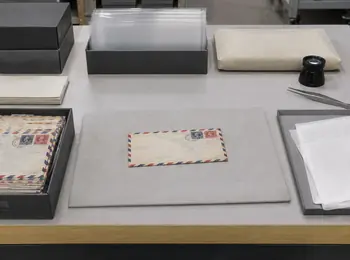
This case covers correspondence connected to John McConnell’s Earth Flag legacy and Earth Day origins. It does not claim to represent his complete personal papers. The evidentiary boundary follows custody: letters, envelopes, and enclosures received by the Earth Flag Foundation through separate gifts.
Four Separate Gates
Never let urgency at one gate answer the others. A splitting fold raises physical priority; it says nothing by itself about donor permission or web publication.
How Donor Boxes Put Earth Flag Letters at Risk
The correspondence did not arrive as one orderly archive. Household boxes held mixed gifts of Earth Flag and Earth Day mail, sometimes in acidic folders and sometimes still folded inside original envelopes. Rusting fasteners joined papers that may once have belonged together, though the surviving arrangement did not always make that relationship clear.
Routine use compounded the problem. A classroom request could mean finding a letter, pulling it from neighboring material, opening thin airmail paper, and then trying to restore the earlier order. Fading ink became harder to read. Tears widened at folds. An enclosure placed beside its letter for decades could lose that context after one busy Earth Day visit.
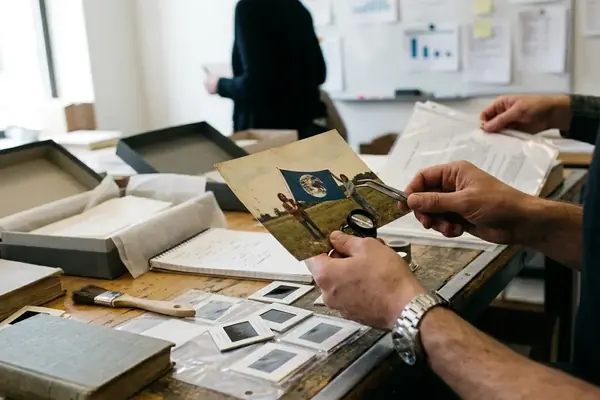
The first response was deliberately modest: review by folder, keep each letter with its envelope and nearby enclosures, and record their relationship before separating anything for imaging or housing. Visible concerns went into the work record in plain language, including fading ink, paper brittleness, fold tears, fastener corrosion, and disrupted order. The team avoided assigning unsupported conservation grades.
That restraint matters. A useful record says what a person can see and what action followed. It does not turn a quick folder review into a testing result.
The boxes could no longer function as a private stash. Educators and historians were already seeking primary traces of the flag’s design, manufacture, display, and use in early planetary advocacy. Those questions sit at the heart of the Earth Flag's history. Answering them by repeatedly handling the originals would gradually consume the evidence people had come to study.
For general handling principles, the Library of Congress guidance on caring for works on paper offers a useful reference. In this project, however, each action still followed the condition and donor status of the particular item in front of the team.
Why Origin Letters Entered the Scanner Queue First
Before anyone used a scanner, every reviewed folder entered one of three queues: image now, rehouse and wait, or do not image. The queue label went onto the box workform first. That small procedural step kept volunteers from creating a new priority system midway through a shift.
The “image now” queue favored unique correspondence about the Authentic Earth Flag, John McConnell’s Earth Day appeals, and early display of the flag. Routine later mail and duplicate acknowledgments waited. A threatened fold could move an obscure correspondent ahead of a familiar name because condition outranked celebrity.
This rule made the work easier to defend. The question was not whose signature looked most impressive. Instead, the team asked which surviving item carried distinctive evidence and faced the greatest handling risk.
The Contextual Group as the Imaging Unit
A letter rarely tells its whole story alone. If the folder also held a return envelope, clipping, sketch, or related enclosure, those pieces remained together in sequence. Imaging only the written sheet could strip away the postmark that supports an inferred date or the flag doodle that explains an otherwise cryptic sentence.
- Image now: unique, relevant material with pressing physical concerns and permission to proceed.
- Rehouse and wait: stable or routine material that can safely follow higher-priority correspondence.
- Do not image: material blocked by donor language or another controlling restriction.
A complicated scoring formula would have given the process a false precision. The three queues kept attention on the paper, the Earth Day legacy, and the evidence held by the full folder.
The Donor Clause That Stops a Scan
Rights review begins with the gift file, deed, and any donor cover note. It happens before a sheet reaches scanner glass.
The controlling language is translated into an operational status: public imaging allowed, staff-only imaging allowed, closed until a stated date, or no imaging. Restrictions are recorded distinctly because “no online publication” and “no imaging” require different handling. Other files may require delayed opening or masking the names of living private individuals in a public description.
A short restriction slug goes on the physical folder and matches the catalog status. The full donor wording remains in the controlled gift file, where staff can review it without crowding a public record with private administrative detail.
The difficult decision arrives when a restricted letter would make an excellent Earth Day lesson. Educational value does not erase donor instructions. Cropping the page, enhancing a flag detail, or publishing only the relevant paragraph still uses the restricted document. None of those maneuvers bypasses the clause.
Honoring a no-scan instruction protects trust with future donors and recognizes the legal and ethical limits of a nonprofit archive. Custody of a letter does not automatically convey every right in its words, artwork, or private information.
Read Before Glass
Attach the donor status to the workform before opening or imaging the item. If permission remains unclear, rehouse the material and stop the digital workflow until the language can be resolved.
Catalog Fields That Reveal an Earth Flag Letter
A scan without description is merely a picture in storage. The catalog record turns it into evidence that an educator or historian can locate, assess, and cite.
Description starts with the page and envelope. The cataloger records the correspondent and recipient as written, the stated date or a supported date range, any stated place, the connection to the Authentic Earth Flag or Earth Day, enclosure types, language, and visible physical condition.
Uncertainty stays visible. If the letter lacks a date, an envelope postmark or a referenced Earth Day activity may support a range. The basis belongs in the record; a cataloger should not silently convert it into a single day. A first name on an unsigned postcard also remains as written unless the envelope, handwriting comparison, or folder context establishes the person’s identity.
Terms Specific Enough to Be Found
The lone tag “environment” hides more than it reveals. Preferred subject phrases include:
- Earth Flag design
- Earth Day 1970 organizing
- UN Earth Trusteeship language
- Flag manufacture and cloth
These terms let a researcher compare letters scattered across donor boxes. They also help a teacher distinguish a document about flag manufacture from one about the philosophical language of trusteeship.
Names receive the same care. The form visible on the item is preserved. A controlled heading is added when the evidence clearly identifies John McConnell or another known correspondent. Guessing from a familiar first name may create a neat catalog, but it creates unreliable history.
Transcribing McConnell Without Polishing His Era Away
Hurried handwriting, aerograms, and duplicated carbon copies can frustrate classroom use even when the scan is sharp. A transcription opens the text while keeping the image as the source.
The sequence matters. The image and item record come first; the transcription follows under the same identifier. Doing so keeps a readable text from drifting away from the page it represents.
The diplomatic transcription proceeds line by line. It retains legible line breaks, capitalization, insertions, deletions, spelling, and period language. Unclear words receive a bracketed query or an illegible marker. The transcriber does not complete a familiar Earth Flag slogan from memory or modernize a period name for the planet.
Images within the writing also deserve a record. A flag doodle in the margin, an arrow between paragraphs, or a small sketch near the signature receives a short placement note. Treating the page as text alone would discard part of McConnell’s visual argument.
Each transcription carries the transcriber’s initials, completion date, review status, and the identifier of the image or physical item. A second reader checks proper names, slogans, dates, and uncertain passages. This review improves usability without smoothing away the voice of the 1970s.
A lightly punctuated classroom copy may be prepared later. It must carry a separate label from the diplomatic transcription so students can tell editorial help from the historical wording.
Publishing the Catalog Before the Correspondence
The public release moves in stages: folder-level catalog first, cleared images second, and checked transcriptions third. This order creates an access trail instead of a bulk upload.
The catalog can establish that a restricted folder exists without reproducing its contents. A public record may say “restricted” and explain the request route. It should not quote the closed page.
Before an image goes live, the rights field and file identifier must agree. Public, staff-only, and closed files remain separate access states rather than slightly different filenames in one upload directory. That distinction lowers the chance that a restricted derivative will be swept into a public batch.
Several kinds of material remain off the open web: donor-banned documents, private letters naming living people who lack a clear public role, and poor-quality reproductions that could be mistaken for original Earth Flag artwork. When a reproduction is known to be a copy, the catalog says so.
Mediated access still has a place. Some McConnell-era files can be shown during an approved, supervised consultation even when they cannot be posted. The request path gives staff room to check the donor terms, explain the item’s status, and protect its physical order.
This custody-to-publication boundary is central to responsible stewardship. The Earth Flag Foundation can acknowledge that evidence survives while preserving the conditions under which it was entrusted.
What Teachers Receive While the Paper Stays Housed
Once a cleared scan and usable catalog note exist, routine classroom and exhibit questions can be answered from the digital surrogate. The original remains in its folder.
A response package may include the cleared image, its transcription status, an item citation, and a catalog note explaining the document’s relationship to the Earth Flag or Earth Day. That package gives an educator enough context to teach from the source without turning a fragile sheet into a traveling prop.
Originals are retrieved for three documented reasons: conservation assessment, verification of a feature that the scan does not show clearly, or an approved supervised consultation. The boundary is practical. It prevents casual repeat handling while leaving a route for serious source work.
Daily work changes as a result. Volunteers spend more time describing enclosures and checking restrictions, and less time unfolding the same Earth Day letter for successive visitors. Researchers can compare flag-related correspondence across donor boxes through identifiers and specific subject terms without rebuilding the physical arrangement on a table.
I find the most useful measure in the workflow is also the plainest: can the next person understand why the item matters, what may be shared, and where the original belongs? When the record answers all three, access and care begin supporting each other.
Credits should identify the archivists and volunteers who reviewed and described the boxes. The record need not borrow authority from an unsupported sponsor or affiliation. The documented labor is sufficient.
A Restricted 1970 Letter, Worked from Intake to Closeout
Consider a 1970 letter discussing display of the Earth Flag around Earth Day. It remains inside its original envelope, and the gift file states “no internet publication.” Here is the complete path a small archive can copy.
- Assign identity. Give the envelope one box number and one item number. Link the donor restriction to that identifier before opening the envelope. Keep the letter-envelope relationship intact.
- Document its arrival state. Photograph the envelope in place as a condition view, with no people in frame. This image records context; it does not authorize publication of the enclosed document.
- Check and house the paper. Note the tears at the folds. If a rusty fastener can be lifted without taking paper or text with it, remove it. Otherwise leave it for later attention. Place the letter and envelope together in an acid-free folder bearing the matching restriction slug.
- Apply the rights gate. Record “no internet publication” as a block on web delivery. If separate gift language permits staff imaging, store the derivative in restricted storage under the same identifier. If it does not permit imaging, make no scan.
- Describe the item. Enter the date and correspondent exactly as written. Add the subjects “Authentic Earth Flag” and “Earth Day 1970,” record “envelope” as the enclosure type, and enter the rights note “no public posting per donor.”
- Prepare internal text only when allowed. If the donor terms permit staff transcription, create a diplomatic version, preserve uncertain readings in brackets, and mark the file internal. Do not release the text when publication of both image and wording is barred.
- Open a lawful discovery route. Publish a catalog record stating that a restricted 1970 Earth Flag letter exists. Give request instructions without quoting the letter or reproducing the page.
- Return and record. Put the folder back in its numbered box position, update the box list, and enter the next action as either the stated review date or “remain closed under current donor terms.”
The result is concrete: the paper rests with its envelope, the donor instruction travels with every record, and a researcher can discover the letter without seeing restricted content. That is how one guarded page can still serve the earth day legacy step by documented step.



Your Thoughts
Leave a comment.