
The Authentic Earth Flag Under Conservation Care
John McConnell designed the Authentic Earth Flag with an image of the planet seen from space set on a deep blue field. Carried for decades as a public sign of planetary unity and tied directly to the origins of Earth Day, surviving early examples now present a dual identity. They remain living civic symbols, yet physically they are aging composite textiles.
A historic flag is cloth paired with an applied planetary image. It cannot endure outdoor wind or permanent public hanging without irreversible loss.
Preserving the history of the Earth Flag requires separating its active ceremonial role from the physical vulnerability of its surviving materials. Custodians protect the artifact by retiring it from routine handling. When an annual observance or classroom lesson calls for the emblem, a modern reproduction carries the visual message into the room, sparing the historic cloth both the handling and the light.
Three operational controls determine whether a historic example endures:
- Light exposure: limiting both the intensity and the total hours of illumination the cloth receives.
- Full physical support: bearing the weight of the entire textile across a rigid plane or distributed mount whenever it is lifted, moved, or shown.
- Baseline documentation: recording the exact construction and existing wear in writing and photographs before anyone attempts to clean, mount, or mend the fabric.
Conservation work begins by treating the blue field, the central Earth image, the structural seams, and the hoist as separate physical components. How the planetary image meets the cloth dictates every storage and display decision. An examiner records whether the Earth was printed directly into the fibers of the blue field, stitched down as a separate textile, or deposited as a surface layer. Each method responds differently to flexing and ambient humidity. When the underlying fabric bends across an old crease, a stiff or degraded planetary surface layer can fracture or lift right along that fold line. Support and housing must therefore be engineered around the most fragile component on the cloth.
Before moving the flag to storage or display, handlers measure the overall height and width without pulling the weave taut. The written file notes the exact position of all seams, hardware attachments, and maker's marks. Taking an overall photograph alongside close detail views gives later custodians a clear visual baseline, allowing them to tell original manufacturing features apart from subsequent wear.
Fading, Folds, and Old Pinholes on the Cloth
Structural damage in historic banners frequently hides until the cloth is spread out under controlled illumination. A thorough condition survey must precede any surface cleaning, framing, or public exhibition. Opening a flag blindly to prepare for an event invites fresh tears along weakened fold lines.
The inspection takes place with the textile resting flat on a prepared table. The examiner starts with an overall visual assessment before directing a low-angle beam—known as raking light—across the plane of the fabric. Raking light throws subtle surface disruptions and raised creases into sharp relief. Because those oblique shadows can look like dark stains in a photograph, the survey notes must distinguish temporary shadow from actual dye discoloration. By comparing the color density of the central Earth disk against the surrounding blue field, and checking sheltered seam allowances where possible, the observer gauges how much photochemical fading has already occurred.
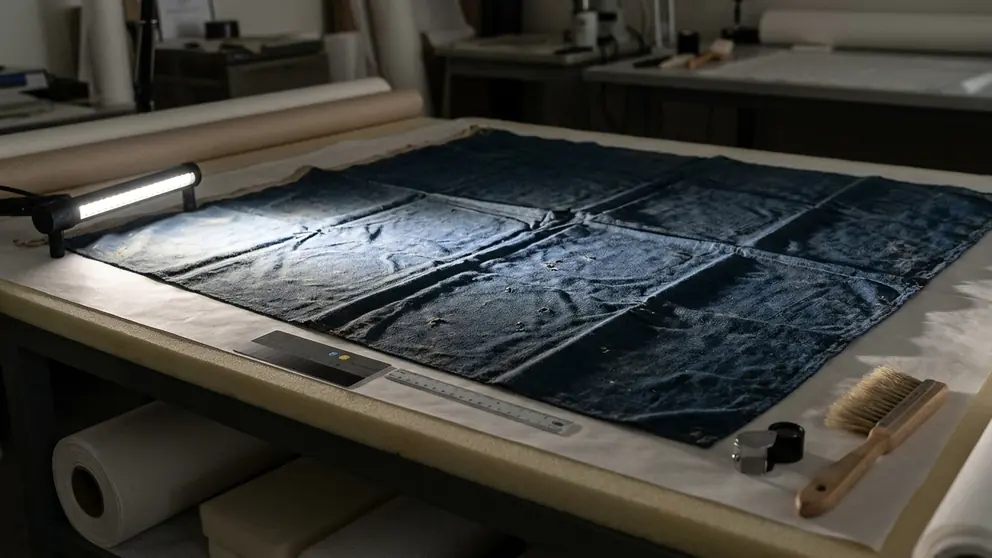
If an old fold resists flattening, the examiner leaves it closed and logs the area as inaccessible. Forcing a brittle crease open to complete a form breaks fibers.
Every defect receives a geographic coordinate tied directly to the anatomy of the flag. Notes that read "fly edge, level with the lower border of the Earth image" remain clear even if a reference photograph is later rotated or cropped. When photographing accessible faces, the documenter places a measurement scale beside the cloth rather than laying it directly on the weave. One digital image or print remains entirely unmarked as an archival master, while specific flaws are mapped onto a duplicate copy.
Separating Distinct Forms of Wear
Lumping all wear under a single note hides the mechanical and chemical history of the piece. Even when two problems overlap in the same corner, they require separate entries in the condition log:
- Mechanical fasteners: pinholes and staple scars from temporary wall hangings, logged with any rust transfer.
- Stitching and weave breaks: snapped seam threads, abraded edges, and sharp creases that have sliced through the warp or weft.
- Surface deposits: aged adhesive residue from old tape or labels, which turns acidic and brittle over time.
- Moisture and biological traces: water marks with distinct tide lines, alongside any insect grazing or casings.
A Board Under the Flag Before It Is Lifted
Tears in aged banners almost always begin at a pinch point. Lifting a flag by two top corners or asking a weakened hoist header to carry the dragged weight of the entire blue field concentrates stress on a few degraded threads.
A safe transfer eliminates suspension during movement. Before anyone touches the textile, the team clears a receiving table larger than the unrolled flag and maps the walking route. Rather than carrying the cloth to a work surface, handlers bring a rigid board—or a clean, pre-washed cotton sheet serving as a tensioned sling—directly to the flag. A smooth barrier layer covers the board so raw edges or coarse fabric cannot snag broken filaments.
The cloth slides onto the horizontal support with minimal flexing. Once the entire textile rests flat, with no fly edge or frayed corner dangling over the perimeter, the handlers lift the board itself and carry it level.
Single-Voice Transfer Protocol
Assign one handler to direct the lift, pace the walk, and call the set-down. Every participant removes rings, watches, and bracelets before approaching the table, and keeps pens, clips, beverages, and survey clipboards on a separate desk well away from the exposed cloth.
Light and Hardware That Consume the Original
Light consumes historic textiles quietly. Every photon absorbed by the printed or dyed Earth image and the blue field breaks molecular bonds, fading the pigments while embrittling the structural fibers underneath. A continuous wall hang in a bright hallway or lobby guarantees permanent loss.
Preparing an original flag for an Earth Day legacy exhibition begins by setting a strict display duration and engineering a physical mount before turning on any gallery lamps. Unfiltered daylight, hot spotlights, and repeated camera flashes must be excluded from the space. To manage cumulative damage, conservation planning commonly uses 50 lux—measured directly at the face of the textile—as an illumination ceiling. This figure serves as an exposure-management reference rather than a safe threshold where fading stops. An eight-hour public showing at a steady 50 lux adds 400 lux-hours of cumulative dose to the artifact's permanent log. Both the measured illuminance and the exact hours under light go into the file, and the cloth stays covered in darkness whenever the room closes.
Mounting hardware poses an equal threat if it concentrates gravity on old seams. Even when a flag has a sewn pole sleeve, slipping a hidden dowel inside still forces the top edge of the cloth to carry the dead weight of the entire field. Fragile banners need distributed support, such as a padded, fabric-covered slanted board that bears the weight across the whole surface. Before placing the original flag on its mount, staff verify that glazing, interpretive labels, and light fixtures cannot touch the fibers, and they test the lit case for localized heat buildup. Mapping every pre-existing pin and staple hole prior to installation ensures that any fresh stress is caught immediately rather than mistaken later for historic wear.
A Dark Box or a Wide Roll Between Showings
Once a brief exhibition closes, the flag returns to dark storage. Choosing between a flat box and a cylindrical roll depends on how the stiffest part of the flag behaves. Flat storage in an archival tray is the first choice whenever the cloth feels brittle, carries sharp structural creases, or shows uncertain adhesion across the planetary disk.
Rolling saves space for large banners, but it demands a joint assessment of both the fabric and the applied graphics. A supple blue field does not prove that rolling is safe; an aged or lifting Earth-image layer can crack across its surface even while the base fabric bends without resistance. If both components flex safely, the flag goes onto a wide archival tube lined with conservation-grade interleaving selected specifically for the identified fibers and print media. Soft interleaving prevents the planetary graphic and old fold ridges from pressing into a tight inner curl.
The storage tube must extend past the vertical width of the flag on both ends, giving handlers bare cylinder margins to grip without squeezing the textile. The written housing record specifies the exact tube diameter in millimeters or inches so future staff can reproduce the curve when updating materials. Ordinary corrugated cardboard, bare wood, and sealed plastic bags that trap dampness must never touch the cloth.
Attaching clear handling diagrams and identification tags to the exterior of the box or wrapper keeps curious observers from unpacking the artifact just to confirm what lies inside. An external housekeeping check every six months tracks water leaks, pest activity, crushed corners, or shifted lids without unrolling the textile.
A Record of Loss, and the Choice to Keep It Dark
Well-intentioned domestic care ruins historic flags faster than quiet neglect. Running a household iron over a creased Earth disk, washing stained cloth in a sink, stitching torn corners at home, or pressing pressure-sensitive tape over a split destroys original evidence and accelerates chemical decay. Identifying the base fiber—whether cotton, nylon, or polyester—never guarantees that the accompanying dyes, surface inks, finishes, or older thread repairs will survive water or heat.
Proper stewardship separates emergency stabilization from physical repair. Stabilization means halting active movement through full horizontal support, dark enclosure, and strict environmental calm. Every time the housing opens, an observer logs the date, their name, updated photographs, and any shift in the flag's posture. If tiny fibers or painted flakes have detached, they go into a labeled enclosure kept inside the flag's primary box—never taped back onto the field or swept away as dust.
A trained textile conservator steps in whenever the survey reveals active material breakdown:
- Fibers that powder or shed dust when lightly touched.
- Sections of the Earth image or field that are lifting or detaching.
- Sticky or yellowed residue from old pressure-sensitive tape and decals.
- Dampness, mold odor, or tide lines from recent wetting.
- Any proposal to lend the flag or place it on extended public view.
Each formal condition entry ends with a plain operational choice for the next requests: either the original flag is cleared to appear on its approved, distributed support under logged low light, or a reproduction takes the flagpole while the historic cloth stays flat and dark. When the next anniversary arrives and the public gathers to look toward the emblem, will your schedule call upon the fragile original to bear the room's light, or let a modern copy carry the symbol while the historic cloth endures in the dark?




Your Thoughts
Leave a comment.